
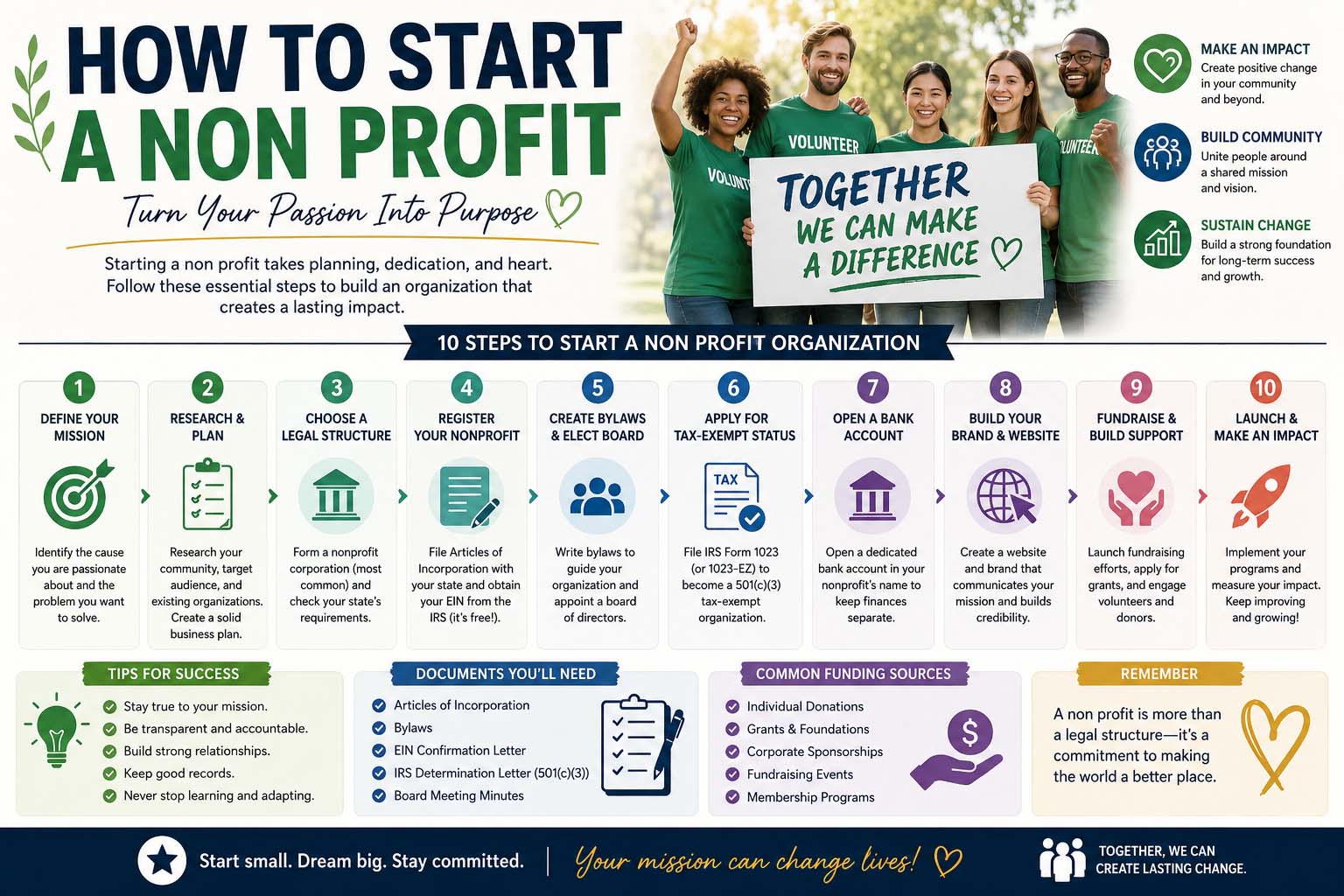
How to Start a Non Profit
Learning how to start a non profit is one of the most rewarding ways to make a lasting impact in your community. Whether you want to support education, rescue animals, fight hunger, or protect the environment, a nonprofit gives you a structured way to turn your passion into meaningful action.
At the same time, launching a nonprofit isn’t simply about having a great idea. Instead, it requires planning, leadership, legal compliance, fundraising, and financial management.
If you’re wondering how to launch one, this guide walks you through every major step, from defining your mission to building a sustainable organization that can grow for years to come. In addition, How to Start a Nonprofit provides further guidance for building a mission-driven organization successfully.
Quick Nonprofit Startup Checklist
| Step | Purpose |
|---|---|
| Define your mission | Clarify your organization’s purpose |
| Research community needs | Confirm demand for your services |
| Write a business plan | Build a roadmap for growth |
| Recruit a board | Create leadership and accountability |
| Register your organization | Meet legal requirements |
| Apply for tax-exempt status where applicable | Access nonprofit benefits |
| Create a fundraising plan | Generate reliable income |
| Launch marketing efforts | Reach donors and volunteers |
What Is a Nonprofit?
A nonprofit organization is created to serve a public benefit rather than generate profits for owners or shareholders.
Unlike traditional businesses, nonprofits use any surplus revenue to support their mission instead of distributing profits to individuals.
For example, common nonprofit sectors include:
- Education
- Healthcare
- Environmental conservation
- Community development
- Animal welfare
- Arts and culture
- Youth programs
- Human services
Although nonprofits have different goals than for-profit companies, they still require careful planning and strong financial management.
Start With a Clear Non profit Mission
Every successful nonprofit begins with a specific mission.
For example, ask yourself:
- What problem are you solving?
- Who will benefit?
- Why does this organization need to exist?
- How will success be measured?
Instead of saying:
“We help children.”
Write something more specific:
“Our organization provides free after-school tutoring and mentoring programs for underserved elementary school students.”
Ultimately, a focused mission makes fundraising, marketing, and decision-making much easier. Moreover, How to Write a Mission Statement explains how to define your organization’s goals clearly.
Research Before You Launch a Nonprofit
Before completing any legal paperwork, spend time understanding the community you want to serve.
In particular, research helps answer questions like:
- Is there a real need?
- Are similar organizations already operating?
- What services are missing?
- Who could become community partners?
For example, talk with:
- Local leaders
- Schools
- Businesses
- Volunteers
- Potential beneficiaries
- Government agencies
As a result, this information helps shape a stronger nonprofit from the beginning.
Create a Non profit Business Plan
Many people overlook this step because nonprofits don’t exist to earn profits.
Nevertheless, a business plan is still one of the most valuable tools you’ll create.
Include sections such as:
Mission Statement
Explain why your nonprofit exists.
Programs and Services
Describe exactly what you’ll offer.
Target Audience
Identify who your organization will serve.
Budget
Estimate:
- Startup costs
- Monthly expenses
- Expected revenue
- Grants
- Donations
Marketing Plan
Outline how you’ll reach donors, volunteers, and community members.
In addition, a well-written business plan strengthens grant applications.
Build a Strong Nonprofit Board of Directors
Most nonprofit organizations need a board of directors.
For example, board members help oversee:
- Strategic planning
- Financial accountability
- Legal compliance
- Executive leadership
- Organizational policies
Look for people with different backgrounds, such as:
- Accountants
- Lawyers
- Teachers
- Healthcare professionals
- Business owners
- Marketing specialists
Ultimately, a diverse board provides valuable knowledge and balanced decision-making.
Register Your Nonprofit Organization
The legal process depends on where you live.
Generally, typical steps include:
- Choosing a unique organization name
- Filing formation documents
- Creating bylaws
- Registering with the appropriate government agencies
- Obtaining any required licenses
However, always check local laws because requirements differ by country and state. Similarly, How to Start a Foundation covers important planning considerations for another type of mission-driven organization.
Apply for Nonprofit Tax-Exempt Status
Many nonprofit founders eventually apply for tax-exempt recognition where available.
For example, potential advantages include:
- Tax benefits
- Eligibility for grants
- Increased donor confidence
- Reduced operating costs
However, requirements vary by jurisdiction, so professional legal or accounting advice can be helpful during this stage.
Open a Dedicated Nonprofit Bank Account
Never mix nonprofit finances with personal accounts.
Instead, opening a separate business bank account helps with:
- Accurate bookkeeping
- Financial transparency
- Donor trust
- Tax reporting
Generally, you’ll need registration documents and identification before opening an account.
Develop a Sustainable Nonprofit Fundraising Plan
Even mission-driven organizations need reliable income.
Therefore, successful nonprofits often combine several funding sources.
Individual Donations
Many organizations rely on recurring monthly supporters.
As a result, small donations can create predictable revenue over time.
Grants
Government agencies and private foundations often provide grants for qualifying nonprofit projects.
Generally, grant applications require:
- A clear mission
- Budget
- Program details
- Measurable goals
Corporate Sponsorships
Businesses frequently support local nonprofits through:
- Financial contributions
- Event sponsorships
- Employee volunteer programs
Therefore, strong community relationships can open new opportunities.
Fundraising Events
For example, popular ideas include:
- Charity runs
- Auctions
- Community dinners
- Online campaigns
- Benefit concerts
In addition, events increase public awareness. These Tips for Networking Events can also help founders develop valuable community relationships.
Membership Programs
Some nonprofits generate recurring income through membership plans that include newsletters, exclusive events, or educational resources.
How to Start a Non Profit Organization: Beyond Legal Registration
If you’re wondering how to start a non profit, this guide explains everything you need to know. After all, starting a nonprofit is one of the most rewarding ways to make a lasting impact in your community.
However, the legal process is only one part of building a successful nonprofit.
Long-term success depends on:
- Strong leadership
- Community support
- Financial planning
- Volunteer engagement
- Clear communication
- Consistent impact
Therefore, think beyond launching and focus on sustainability from day one.
Build Your Nonprofit Brand
Your nonprofit needs a recognizable identity.
Develop:
- Organization name
- Logo
- Color palette
- Website
- Social media accounts
- Mission statement
In addition, a professional website should clearly explain:
- Your mission
- Current projects
- Ways to donate
- Volunteer opportunities
- Contact information
Ultimately, a trustworthy brand encourages community support.
Recruit and Retain Nonprofit Volunteers
Volunteers are often the foundation of nonprofit organizations.
For example, create a positive experience by:
- Offering training
- Defining responsibilities
- Celebrating achievements
- Providing regular communication
- Listening to feedback
As a result, people are more likely to stay involved when they feel appreciated, recognized, and valued for their time, contributions, and commitment to your organization’s mission.
Moreover, as your nonprofit grows, Human Resources Outsourcing Services may help manage administrative and workforce responsibilities more efficiently.
Promote Your Nonprofit Mission
Marketing isn’t just for businesses.
In fact, nonprofits also need visibility.
Useful channels include:
- Email newsletters
- Local newspapers
- Community events
- Public speaking
- Blog content
For example, share stories showing how your work changes lives.
Ultimately, real examples help build emotional connections with supporters.
Measure Your Nonprofit Results
Donors appreciate seeing the difference their support makes.
Therefore, track meaningful outcomes such as:
- Families assisted
- Animals rescued
- Scholarships awarded
- Volunteer hours
- Meals served
- Trees planted
- Funds raised
In addition, annual reports help demonstrate accountability and progress.
How to Start a Nonprofit Animal Rescue: Building a Mission to Help Animals
Many aspiring founders specifically search how to start a non-profi animal rescue because the need for animal welfare organizations continues to grow.
For example, additional planning may include:
- Shelter facilities
- Foster networks
- Veterinary partnerships
- Adoption procedures
- Animal transportation
- Emergency care plans
- Volunteer training
In particular, working with local veterinarians and shelters often strengthens rescue efforts.
Benefits of Starting a Nonprofit
Launching a nonprofit offers many rewards.
For example, advantages include:
- Making a lasting community impact
- Building meaningful partnerships
- Inspiring volunteers
- Creating educational opportunities
- Supporting important causes
- Qualifying for grants and charitable donations
Ultimately, many founders find deep personal satisfaction through community service.
Nonprofit Challenges to Expect
Running a nonprofit also brings responsibilities.
For example, common challenges include:
- Fundraising uncertainty
- Volunteer recruitment
- Administrative work
- Regulatory compliance
- Financial management
- Limited staffing
Therefore, planning ahead helps reduce these obstacles.
Common Mistakes New Nonprofit Founders Make
Avoid these frequent mistakes.
Mission That Is Too Broad
Generally, specific missions attract stronger support.
Depending on One Funding Source
Instead, diversify donations, grants, sponsorships, and events whenever possible.
Weak Financial Records
After all, good bookkeeping builds donor confidence.
Poor Communication
Keep donors, volunteers, and community partners informed about your progress.
Expanding Too Quickly
Therefore, build stable programs before launching additional services.
Best Practices for Long-Term Nonprofit Growth
Successful nonprofits often share similar habits.
For example, they:
- Review strategic goals annually.
- Train board members regularly.
- Communicate openly with donors.
- Measure outcomes consistently.
- Build strong community partnerships.
- Celebrate volunteer contributions.
- Update fundraising strategies as they grow.
Ultimately, continuous improvement helps organizations remain effective.
Example Nonprofit Startup Timeline
| Timeline | Goal |
|---|---|
| Month 1 | Define mission and research community needs |
| Month 2 | Build board of directors |
| Month 3 | Write business plan and budget |
| Month 4 | Register the nonprofit |
| Month 5 | Apply for tax-exempt status if applicable |
| Month 6 | Launch website, fundraising, and community outreach |
However, actual timelines vary depending on legal requirements and organizational goals.
Frequently Asked Questions About Starting a Nonprofit
How Much Money Does It Take to Start a Nonprofit?
Startup costs vary depending on registration fees, insurance, office space, technology, and program needs. For example, some nonprofits begin with only a modest budget, while larger organizations require significantly more funding.
Can One Person Start a Nonprofit?
A single founder can begin the process, but many jurisdictions require a board of directors to oversee governance.
Can Nonprofit Founders Receive a Salary?
Yes. In many places, founders and employees may receive reasonable compensation for their work if it follows applicable laws and nonprofit policies.
How Do Nonprofits Earn Money?
Generally, common funding sources include donations, grants, sponsorships, fundraising events, membership fees, and program service revenue.
How Long Does It Take to Establish a Nonprofit?
The timeline depends on local regulations. Therefore, registration and tax-exempt approval can take anywhere from a few weeks to several months.
Is Running a Nonprofit Easier Than Running a Business?
Not necessarily. Nonprofits still require budgeting, leadership, marketing, compliance, fundraising, and strategic planning to remain successful.
Your Next Nonprofit Steps
Learning how to start a non profit is about much more than completing legal paperwork. A successful organization begins with a clear mission, careful planning, strong leadership, and a commitment to serving the community. By researching local needs, creating a realistic business plan, recruiting dedicated board members, and developing a sustainable fundraising strategy, you’ll build a solid foundation for long-term success.
Whether you’re exploring how to start a non-profit, how to start a nonprofit ow to start a non profit animal rescue, how to start a non-profit organization, or planning How to Start a Nonprofit Animal Rescue, remember that meaningful impact grows over time. Therefore, focus on serving your mission well, building trust with supporters, and adapting as your organization grows. Those steady steps can help turn your vision into a nonprofit that makes a real difference for years to come.